
Introduction
Procurement cost savings strategies have never been more critical — or more achievable — than they are in 2026.
With inflation pressures persisting, supply chains remaining volatile, and budgets under scrutiny across every sector, organisations are looking to their procurement functions to deliver measurable financial value. And for good reason.
Procurement typically represents 40–80% of total organizational spend — making it one of the most powerful levers available to improve margins and cash flow.
Yet despite this enormous potential, most organizations capture only a fraction of available savings. The reason isn’t a lack of opportunity — it’s a lack of visibility, strategy, and the right tools to execute consistently.
This guide outlines 7 proven procurement cost saving strategies that SMEs, large enterprises, and government agencies are using in 2026 to reduce costs, eliminate waste, and drive sustainable long-term value. Each strategy is actionable, measurable, and significantly more effective when supported by a modern eProcurement platform.
The Numbers Behind Procurement Cost Savings in 2026
Before diving into the strategies, it helps to understand the scale of opportunity:
Well-executed procurement programes consistently deliver 5–20% annual cost reductions across managed spend.
Organizations with top-quartile procurement maturity achieve EBITDA margins at least five percentage points higher than less mature peers.
Automation reduces transaction processing costs by up to 90% — cutting manual processing expenses dramatically.
Most organizations uncover 10–15% in immediate savings opportunities through spend visibility alone.
These aren’t theoretical numbers. They are the outcomes of organizations that have made procurement cost saving a strategic priority — not an afterthought.
1. Start with Spend Analysis — You Cannot Save What You Cannot See
The foundation of every effective procurement cost saving strategy is spend visibility. Spend analysis means consolidating all purchasing data — across procurement systems, accounts payable, purchase cards, and contracts — and structuring it by supplier, category, department, and item.
Without this visibility, cost saving is guesswork. With it, patterns emerge quickly: duplicate suppliers, off-contract purchases, category consolidation opportunities, and pricing inconsistencies that are costing your organization every month.
💡 Result: Most organizations uncover 10–15% in immediate savings opportunities from spend visibility alone — before any renegotiation or process change takes place.
2. Consolidate Your Supplier Base to Increase Purchasing Power
Supplier fragmentation is one of the most common and costly hidden expenses in procurement. When organisations buy similar goods or services from too many vendors, they dilute their volume leverage, multiply administrative overhead, and weaken their negotiating position across the board.
Strategic supplier consolidation — identifying supplier overlap across categories and business units, then concentrating spend with fewer, stronger partners — consistently delivers both immediate savings and long-term value. Supplier consolidation typically yields 5–10% cost reductions, while group purchasing arrangements can return 18–22%.
💡 Result: Fewer suppliers, stronger relationships, better commercial terms — and significantly reduced supplier management costs.
3. Negotiate Smarter — Renegotiate Contracts Before They Auto-Renew
Contract management is one of the fastest and most underutilised procurement cost saving opportunities. Many organisations lose 3–7% of savings every year simply because contracts are not actively managed, renegotiated, or enforced correctly.
Any contract not reviewed for more than three years almost certainly contains opportunities for cost reduction. Pricing that was competitive three years ago may no longer reflect current market rates. Procurement teams that proactively benchmark supplier pricing and approach renegotiations with market data consistently secure better terms — before auto-renewal locks in last year’s pricing.
💡 Result: Better pricing, improved payment terms, stronger contract performance, and avoided cost escalation.
4. Apply Strategic Sourcing to High-Value Categories
Strategic sourcing is where procurement moves from reactive to genuinely value-driven. By identifying high-impact spend categories and introducing structured competition through RFQs and RFPs, procurement teams consistently achieve 8–15% cost reductions on renegotiated categories.
The real value of strategic sourcing, however, goes beyond unit price. It shifts the conversation toward total cost of ownership — factoring in delivery, quality, reliability, and supplier risk — ensuring every sourcing decision protects margins over time, not just in the current quarter.
💡 Result: Sustainable cost reductions, stronger supplier relationships, and sourcing decisions aligned with long-term organizational goals.
5. Automate Procurement Processes to Cut Administrative Costs
Manual procurement processes are expensive — not just in terms of the direct cost of processing transactions, but in the staff time, error rates, and compliance risks they generate. Automation reduces transaction processing costs by up to 90%, freeing procurement teams from administrative burden and allowing them to focus on strategic value creation.
Source-to-Pay automation — covering everything from purchase requisitions and supplier onboarding to purchase orders, invoicing, and payment processing — eliminates the bottlenecks, delays, and errors that characterize manual procurement workflows. For organizations managing high transaction volumes, the return on investment from procurement automation is typically realized within months.
💡 Result: Dramatically reduced administrative costs, faster procurement cycles, fewer errors, and procurement teams freed to focus on strategic sourcing.
6. Build Compliance In — Avoid the Hidden Costs of Non-Compliance
The cost of procurement non-compliance extends far beyond fines and penalties. Reputational damage, audit remediation costs, supplier disputes, and the internal management burden of reactive compliance fixes represent a significant — and entirely avoidable — drain on organizational resources.
Embedding compliance requirements directly into procurement workflows — from supplier onboarding and sourcing events to contract management and payment processing — creates audit-ready processes by default. For government agencies and NGOs especially, procurement compliance is not optional: it is a prerequisite for maintaining public trust, donor confidence, and institutional credibility.
💡 Result: Reduced compliance costs, eliminated audit remediation expenses, and procurement processes that are always audit-ready.
The Common Thread: Visibility, Control, and the Right Technology
Looking across all seven strategies, a clear pattern emerges. Every one of them is more effective — and more sustainable — when procurement teams have real-time visibility into spend data, centralized control over supplier relationships, and the right digital infrastructure to execute consistently at scale.
Manual procurement systems cannot deliver this. Spreadsheets, email chains, and fragmented purchasing processes actively undermine every cost saving initiative an organization attempts.
Procurement cost savings are not achieved through ad-hoc initiatives. They require sustained visibility, disciplined execution, and systems that enforce good procurement practice across every transaction.
This is precisely why the shift to digital, eProcurement platforms is accelerating across every sector in 2026. Organizations that have invested in procurement technology are not just saving more — they are saving consistently, measurably, and sustainably.
How SwiftPro by AIG Pro Inc. Delivers Every One of These Strategies
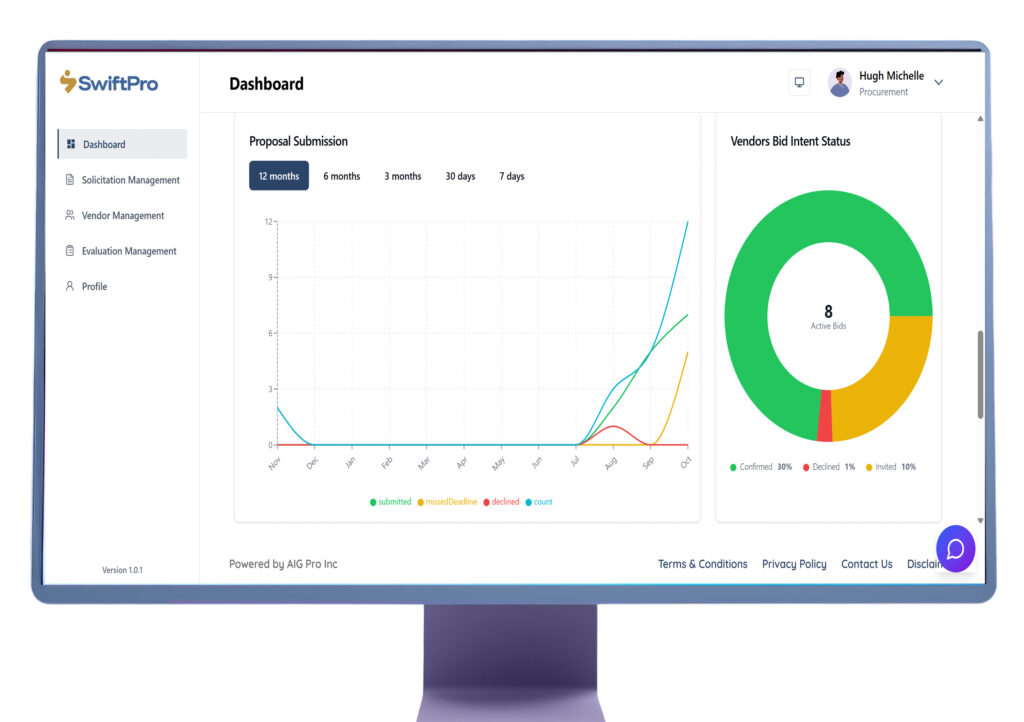
SwiftPro is AIG Pro Inc.’s end-to-end eProcurement portal, built to give SMEs, large enterprises, and government agencies the tools to implement every cost saving strategy outlined in this guide — in one centralized, intuitive platform.
Real-time spend analytics: Complete visibility into what your organization is buying, from whom, and at what cost — continuously, not at month-end.
Centralized supplier management: Consolidate your vendor base, track performance, and manage compliance documentation in one place.
Source-to-Pay automation: From RFx to invoice, every step of the procurement cycle digitized and streamlined — cutting administrative costs dramatically.
Contract management tools: Active contract tracking, renewal alerts, and benchmarking support to ensure you never miss a renegotiation opportunity.
Built-in compliance tools: Regulatory requirements embedded into every workflow — so audit readiness is a permanent default state.
Whether you are managing procurement for a 50-person SME or a government agency overseeing complex multi-supplier contracts, SwiftPro scales to deliver measurable cost savings from day one.
Conclusion: Procurement Cost Savings Are a Strategy, Not a Tactic
The organizations consistently achieving the greatest procurement cost savings in 2026 are not the ones cutting the hardest — they are the ones with the best visibility, the most disciplined processes, and the smartest use of technology.
Cost saving in procurement is not a one-time project. It is a continuous discipline that requires real-time data, strategic supplier relationships, and systems that enforce good procurement practice across every transaction, every category, and every department.
The strategies in this guide provide a proven framework. SwiftPro by AIG Pro Inc. provides the platform to make them operational — consistently, measurably, and at scale.